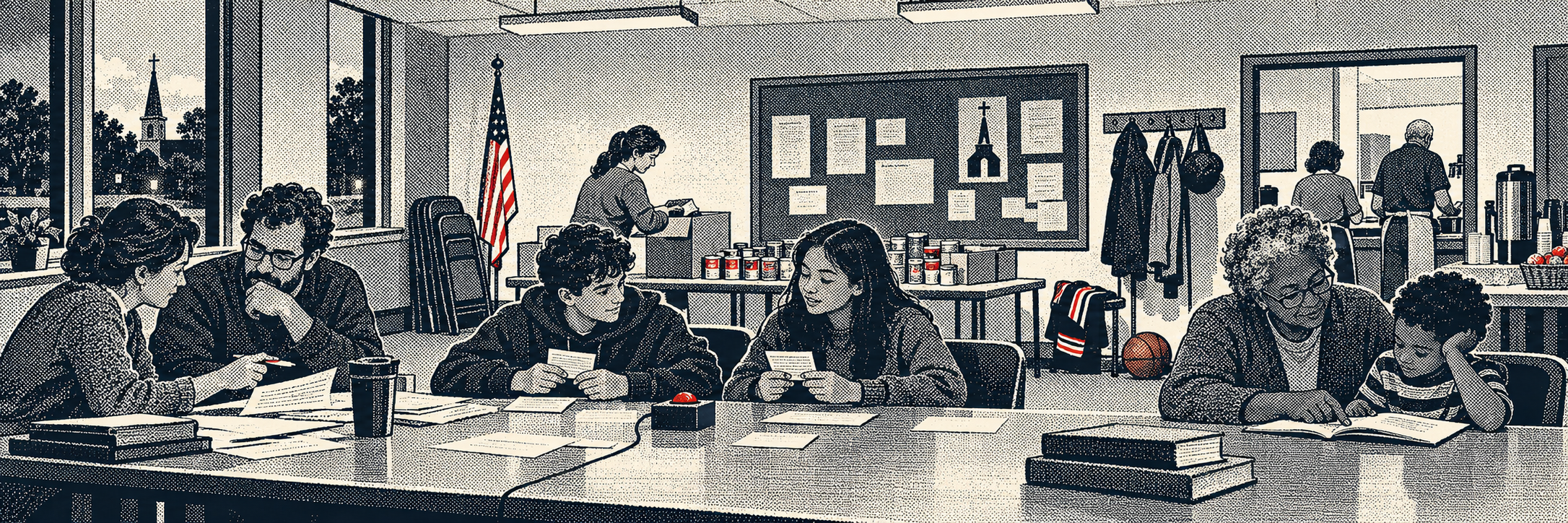
Union legitimacy broadens as labor power remains contested; industrial policy hardens into governing practice; constitutional rules become partisan terrain; and debates over faith, science, war, and local trust reveal the shape of an unsettled order.
By Preserving America’s Purpose12-minute readReporting current through September 7
Fig. 001 :: Morning in the Republic
Welcome
What this publication is for
American politics is being reordered faster than the vocabulary used to describe it. Coalitions are loosening. Institutions are testing the edges of their authority. Ideas once assigned neatly to left or right—industrial policy, restraint abroad, labor power, religious pluralism, technological acceleration—are returning in altered combinations.
Preserving America’s Purpose exists to examine that reconstruction without turning it into a team sport or reducing the nation’s purposes to electoral realignment alone. Each edition separates reported facts from arguments made by participants and from our own interpretation. It will bring serious competing positions into the same frame and stay with proposals long enough to see whether they become institutions, policy, and results.
Opening synthesis
Realignment is a change in bargains, not merely a change in ballots.
The most revealing political movements this week are not clean ideological conversions. They are negotiations over what the state should build, what institutions may decide, which public voices represent a religious tradition, and whether the local associations between citizen and nation can still carry weight.
Consider the crosscurrents. A majority of Republicans now approve of labor unions, yet Republicans still oppose giving unions more influence. House Republicans are advancing domestic mining through a House-passed permitting bill while the administration’s G20 technology framework pairs public research investment with lighter regulation. Bonnie Kristian’s defense of ordinary evangelicals separates institutional faith from its loudest political representatives without denying the consequences of their votes. The executive branch is simultaneously demanding more transparency from public science and locating enforcement of those standards inside presidential administration.
None of this proves that a new settlement has arrived. It shows the terms under negotiation. The old labels still describe tribes; they increasingly fail to describe the bargains those tribes are willing to make.
Labor and coalition
Unions gain legitimacy without winning agreement on power
What happened. Gallup’s August survey found that 71% of Americans approve of labor unions. That includes 52% of Republicans—the second Republican majority in the series in 25 years—alongside 70% of independents and 89% of Democrats. A record 47% of all adults want unions to have more influence. But Republicans preferred less influence to more by 49% to 19%.
The argument. That split is visible inside the labor movement. Pennsylvania Teamsters leaders endorsed Republican Representative Rob Bresnahan after local delegates had backed Democrat Paige Cognetti. State union president Bill Hamilton framed the choice as support for a candidate who had backed labor priorities; a national executive-board dissenter argued that such outreach conflicts with the broader Republican record on collective bargaining.
Our interpretation. Organized labor is becoming culturally acceptable across party lines faster than it is becoming a shared governing commitment. Candidate-by-candidate bargaining may loosen the Democratic–labor alliance, but approval ratings and selected endorsements do not show a wholesale partisan transfer. The interesting change is permission: more actors now believe labor can be negotiated with rather than inherited by one party.
Industry and state capacity
The emerging formula: an active state with a light regulatory hand
What happened. The House passed the Protecting Domestic Mining Act 218–201 on September 2, with all voting Republicans and seven Democrats in favor. The bill would add mining and mineral processing to the projects eligible for the FAST Act’s coordinated permitting framework. Separately, G20 innovation ministers meeting under the U.S. presidency adopted a six-pillar statement covering pro-innovation regulation, public-sector AI, workforce, intellectual property, standards, and investment in industrial supply chains.
The argument. House Republicans present faster mining approvals as a route to domestic jobs and less dependence on foreign competitors while retaining environmental review. The administration’s Carolina Principles make a parallel case in technology: government should fund foundational research and commercialization, use existing sector-specific frameworks where possible, and add new rules only when novel technology raises issues those frameworks cannot address.
Our interpretation. This is not laissez-faire restoration. It is a governing style that treats public coordination, strategic investment, and permitting reform as complementary. The state is asked to build capacity and choose priorities while restraining the procedures that can delay execution. That combination—more national purpose, fewer process vetoes—is becoming a recognizable strand of right-of-center industrial policy.
Fig. 002 :: Capacity is a civic virtue
Faith and republic
The evangelicals who didn’t disappear
What happened. In a September 6 Vox interview about her new book, In Defense of Evangelicalism, Christianity Today deputy editor Bonnie Kristian argues that public discussion has conflated a loud, Trump-supporting white evangelical voting bloc with the whole evangelical faith tradition. She does not defend the alliance with Trump as healthy. She says advancing a party or politician is not the purpose of evangelical Christianity and calls the movement’s close political identification damaging.
The argument. Kristian distinguishes prominent leaders from ordinary voters, who bear different kinds of moral and political responsibility. Her “obligation voter” account explains many Republican votes as the combined result of a felt duty to vote, insistence on choosing a viable major-party candidate, and opposition to abortion—not necessarily approval of Trump’s character or full program. She also argues that ordinary congregations remain more centered on worship, local service, and Christian discipleship than coverage of celebrity pastors and political activists suggests.
Our interpretation. This is the religious question an electoral account of realignment can miss. A voting bloc may remain stable even while the tradition’s internal moral and institutional life is neither captured by its loudest spokesmen nor innocent of its political consequences. Kristian offers neither absolution nor apostasy. She argues for reform without reducing evangelicalism to Trumpism, leaving room to examine how a religious tradition can be politically implicated without being politically exhausted.
What happened. The Department of Health and Human Services’ 2026 annual report on “Gold Standard Science” says the department revised its scientific-integrity policy, supports publishing raw data and code when feasible, encourages preregistration and appropriate controls, and treats null and negative results as publishable. It also documents AI use at ARPA-H, CDC, FDA, and NIH. For ARPA-H proposal evaluations, the report says human experts retain responsibility for all evaluation decisions.
The argument. The governing executive order defines nine scientific-integrity principles, including transparency about uncertainty and reproducibility. It makes agency heads responsible for implementation, with roles for the Office of Science and Technology Policy and the Office of Management and Budget, while requiring each agency’s internal review and enforcement process for alleged violations to be administered under a senior appointee designated by the agency head.
Our interpretation. The administration is combining suspicion of inherited expert institutions with a strong executive claim to define the procedures that make expertise trustworthy. Open methods may improve scrutiny; political control over the integrity regime raises a separate institutional question. The report documents adoption and activity, not whether the reforms improve scientific reliability or public trust.
Civic and associational life
The local advantage is a hypothesis worth testing carefully
What happened. A Trust for Civic Life survey reached 1,029 people through civic networks in 24 rural communities. Seventy-four percent said neighbors and local organizations could come together to solve community problems; 11% said national leaders ensured that their voices mattered. Libraries, nonprofits, and community foundations each received average trust levels above 80%.
The argument. In Dædalus, Charlie Brown and Christina Jodice argue that shared work on concrete local problems builds trust, agency, and belonging more effectively than dialogue by itself. A companion essay by Daniel Stid contends that democracy reform has overinvested in election rules and national institutions while neglecting the associations between citizen and state.
Our interpretation. The mechanism is plausible: institutions can earn trust by helping people do something together, not merely asking them to agree. But the survey is a network-recruited sample rich in community leaders, not a representative picture of rural America. Treat it as a map of promising institutional practice, not a national estimate.
Fig. 004 :: The work between elections
Foreign responsibility
An Iraq deployment approaches its planned end as the “forever war” argument returns
What happened. U.S. and Iraqi officials told the Associated Press that remaining American forces were on track to leave Iraq by September 30 under a previously agreed timetable. The withdrawal was announced and scheduled at publication, not yet complete.
The argument. In an interview published September 6, former Defense Secretary Leon Panetta argued that the continuing conflict with Iran risks reproducing the open-ended wars of Iraq and Afghanistan. The Pentagon rejected the interview’s premise that its leadership was in disarray and described current changes as reform.
Our interpretation. The Iraq legacy no longer sorts the right as neatly as it once did. Restraint can now be articulated as an America-first rejection of strategic overextension; intervention can be defended through deterrence and U.S. credibility. A deployment’s planned end does not settle that argument. It makes the contrast between institutional memory and renewed risk harder to ignore.
Around the table
Three more signals to watch
History as administrative leverage
An Interior Department letter warned that agencies could cut off assistance to the Smithsonian under its current leadership, including artifact loans for exhibits, procurement help, and discretionary grants, escalating a dispute over how the National Museum of American History presents race, immigration, identity, and inequality.
Gallup found a record 45% identifying as independents in 2025. Pew’s 2026 benchmark found 44% independent or “something else.” With leaners included, Democrats held a modest edge in both measures. Coalition fluidity is visible; a settled new majority is not.
Missouri’s highest court held that the state’s 2025 congressional map is subject to referendum, restoring the 2022 map unless voters approve the new one. Missouri asked the U.S. Supreme Court for a stay. State constitutional process is becoming a central arena of national redistricting.
College football is still a map with shoulder pads
Labor Day weekend closes tonight with SMU visiting Florida State. On paper it is merely the last ranked game of opening weekend. In practice it is another reminder that college football remains one of the few national institutions organized around intense loyalty to particular places. The sport asks millions of Americans to know where Tallahassee is, what Dallas thinks it is becoming, why a marching band matters, and how a campus can represent a region far beyond its enrollment.
Conference realignment keeps trying to turn that inheritance into inventory. The stubborn local rituals keep surviving the spreadsheet. That tension may be college football’s most American feature: commerce rearranges the map, and then everybody shows up wearing the old colors anyway.
The next stage of realignment will be visible when coalitional experiments become durable organizations, when policy announcements survive implementation, and when new claims about national purpose create measurable public goods rather than new slogans. Future issues will follow that chain: proposal → adoption → implementation → outcomes.
Before tomorrow’s card
Take one headline that irritated you today. Strip away the personality. What institution actually moved? What material consequence followed? What evidence would change your mind?
If you read all of that, enjoyed it, or simply need a daily reminder that America is still a place where good things happen, come back tomorrow for a fresh batch of insights and reassurance.
Tomorrow :: Three stories where the real action is happening underneath the outrage.
Fig. 005 :: Leave the light on
Legacy terminal :: Modern uplink active :: Still hopeful