Trump Is Trolling. America Is Building.
A map of “New America” seized the feed. The more consequential map runs from Texas water works to a proposed Louisiana spaceport: reservoirs, transmission lines, launch pads, marsh, ports, workers, and the public institutions that must turn ambition into shared abundance.

Donald Trump is trolling again. Over Labor Day, the president promoted maps relabeling New Mexico as “New America,” while the White House account helped the image travel. New Mexico’s governor objected. Reporters explained, correctly, that the federal government cannot rename a state. The cycle performed exactly as these cycles now do: provocation, outrage, clarification, repetition.
The episode is useful because it shows how quickly public attention can be made unserious. A map is altered, a name is teased, and the country is invited to spend the afternoon arguing over whether an insult should be treated as a plan.
But a republic cannot live on reaction time alone. Beyond the feed, Texas has adopted a water plan for a state projected to hold more than 52 million people by 2080. The same plan admits that data centers and AI arrived too late, and with too little usable information, to be fully incorporated into this planning cycle. Across the line in Louisiana, SpaceX and state officials have announced a proposed $100 billion launch complex at Pecan Island. It could bring thousands of jobs, a new industrial ecosystem, local revenue, and coastal work. It could also impose roads, water, power, safety, habitat, and governance burdens on a small coastal community that learned about much of the project from the outside.
Brownsville, Starbase, Houston, Lake Charles, Baton Rouge, Shreveport, and Pecan Island are not the same place. They belong, however, to the same argument: whether American ambition can be converted into water, energy, ports, labor, data, launch capacity, and public institutions sturdy enough to make growth livable.
The attention trap is working exactly as designed.
What materially changed in the New Mexico episode? Public attention moved. No state name changed. No legislation was introduced in the reporting inspected for this edition. No administrative machinery capable of producing the advertised result was set in motion. Reuters reported on September 7 that the president promoted the idea and that the federal government lacks authority to rename a state.
That does not make presidential symbolism meaningless. Supporters can read the gesture as swagger in a trade dispute or as nationalist theater; opponents can read it as contempt for a state whose name predates the republic. Symbols can shape coalition identity. But symbolism becomes an attention trap when every observer is induced to treat the provocation itself as the country’s principal work.
The sensible rule is simple: ask what institution moved, what legal or material consequence followed, and who must implement it. If an executive order, agency action, congressional proposal, diplomatic demand, or measurable electoral shift follows, cover that consequence. Until then, say plainly that the president is trolling and move to the load-bearing story.
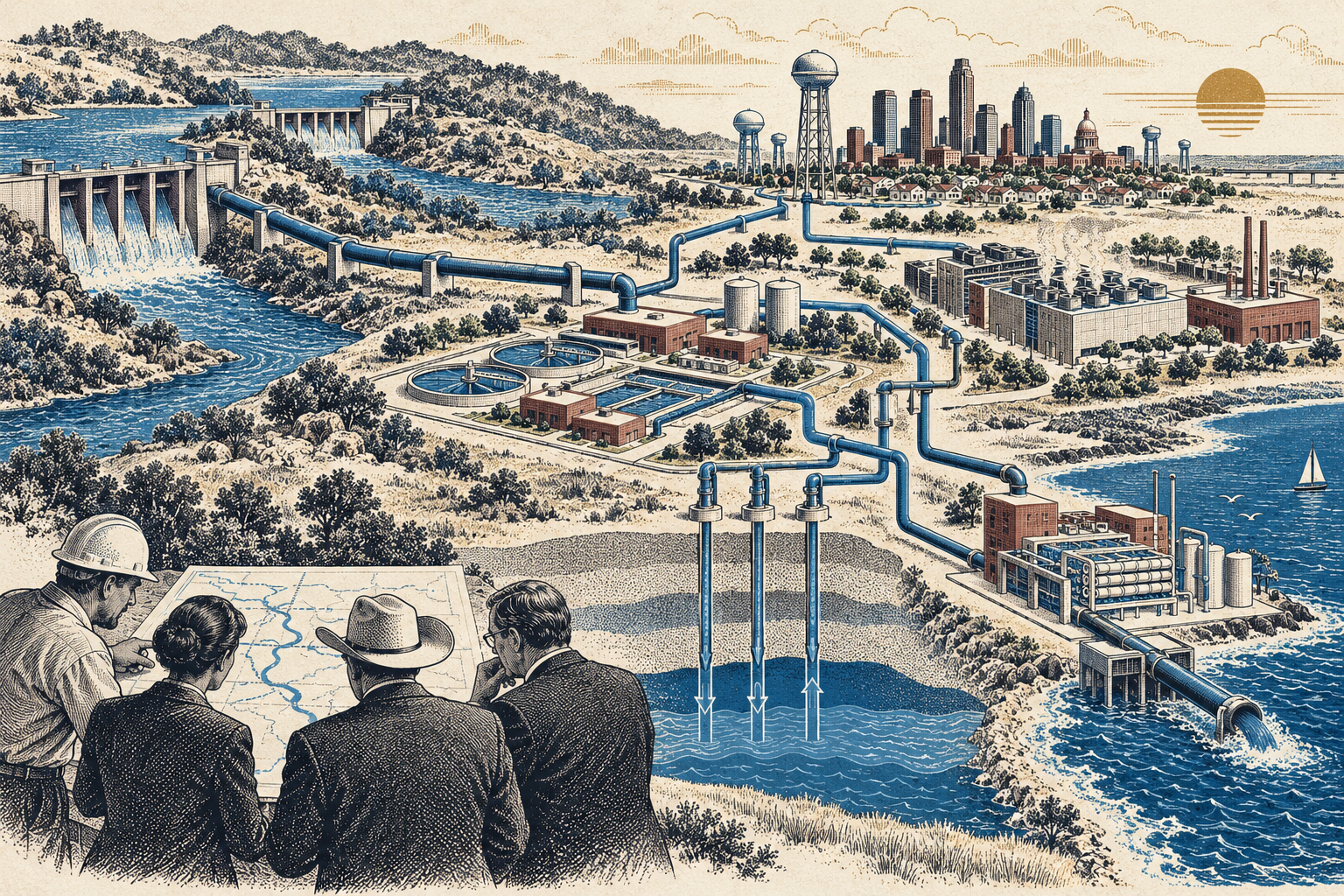
Texas has moved water from slogan to ledger.
The Texas Water Development Board adopted the Phase I 2027 State Water Plan on July 23. It is not a ribbon-cutting announcement. It is a long-range accounting system assembled from sixteen regional plans, more than 500 planning-group members, thousands of strategies, named project sponsors, projected supplies, and estimated costs.
The plan projects that existing supplies reliable during drought will decline about 10 percent between 2030 and 2080, chiefly because of aquifer depletion, with smaller losses from reservoir sedimentation. Its response is not one ideological instrument. About 30 percent of the recommended 2080 strategy volume comes from conservation. The rest includes surface-water development, reuse, brackish-groundwater and seawater desalination, aquifer storage, new wells, and reservoirs.
This is what abundance looks like before the photographs: not one miracle technology, but institutions capable of comparing many technologies, financing them, assigning sponsors, and revising assumptions. Texas has also appropriated $1.038 billion for a one-time grant program. The scale is serious. It is still a fraction of the plan’s multi-decade price tag.
The next test is project conversion. Which sponsors can acquire land, finish design, obtain permits, close financing, begin construction, and deliver water on time? A plan becomes capacity only when the queue of strategies turns into operating systems.

The AI boom arrived faster than the water model.
The most important sentence in the Texas plan may be its admission of incompleteness. Interest in data-center water use rose late in the five-year planning cycle. The board says available data were limited, and none of the sixteen regional groups requested a digital-infrastructure adjustment to their demand projections. The agency is improving its data collection for future cycles.
Meanwhile, ERCOT reported to the Texas Senate in July that it was tracking roughly 474 gigawatts of large-load interconnection requests, about 90 percent associated with data centers. That figure is a queue, not a forecast and certainly not 474 gigawatts of facilities that will be built. It is still an unmistakable planning alarm. Even a modest fraction would alter the scale and geography of power demand. Direct cooling-water needs vary greatly by technology, and indirect water demand depends on how electricity is generated. Those facts make disclosure more important, not less.
Texas should not answer uncertainty with a moratorium disguised as prudence. It should answer with better instruments. Before a large digital load receives final water, power, or local incentive commitments, project sponsors should disclose a bounded range of direct and indirect water demand, cooling technology, intended source, drought operations, reuse potential, and the public infrastructure they expect others to finance. Utilities and regional planners need a common ledger that distinguishes speculative queues from contract-backed projects.
Growth is not the enemy of planning. Growth is the reason to become good at it.
Pecan Island is the good Elon problem.
On August 25, SpaceX and Louisiana officials announced plans for a launch complex in Vermilion Parish. Louisiana Economic Development says the company proposes to invest $100 billion, create 3,000 direct jobs over ten years at an average annual salary of $92,600, begin construction in 2027, and target a first launch as early as 2029. At full buildout, the announced concept includes ten launch pads, propellant production, power generation, vehicle processing, and housing.
Those numbers are promises and projections, not an operating spaceport. Yet the public terms already reveal more than a press release’s rocket animation. LED says the incentive package is conditioned on capital investment, job creation, and a $25 million gift to the Community Foundation of Acadiana. It says a local payment-in-lieu-of-taxes agreement begins with $25 million annually for twenty-five years, includes an escalator and a $20 million upfront payment, and is expected to generate more than $820 million in direct local payments. The state also expects SpaceX to use new aerospace and high-impact-job incentives.
The harder questions sit where the launch complex meets the chenier plain. Residents told The Current that they were excluded from early deliberations and worry that roads, emergency response, water, habitat, and local government are not ready for construction at this scale. Their position is more serious than the usual caricature of progress versus obstruction. Some are open to the project if jobs, environmental protection, restoration, and public preparation are real.
There is also a caution in the coastal money. Early coverage described a $100 million contribution to the state’s coastal plan. More recent reporting quotes the Coastal Protection and Restoration Authority’s executive director saying there is no predetermined SpaceX contribution to CPRA or fixed restoration acreage. Some coastal funding may come from the company’s land purchase, required wetland mitigation, voluntary work, or later agreements. Those are different mechanisms and should not be blended into one triumphant number.
The question is whether private technological ambition can be governed into shared abundance: whether a company that needs land, roads, water, power, ports, skilled labor, emergency services, and permission will leave behind public works, durable employment, coastal repair, and civic confidence instead of only disruption and resentment.
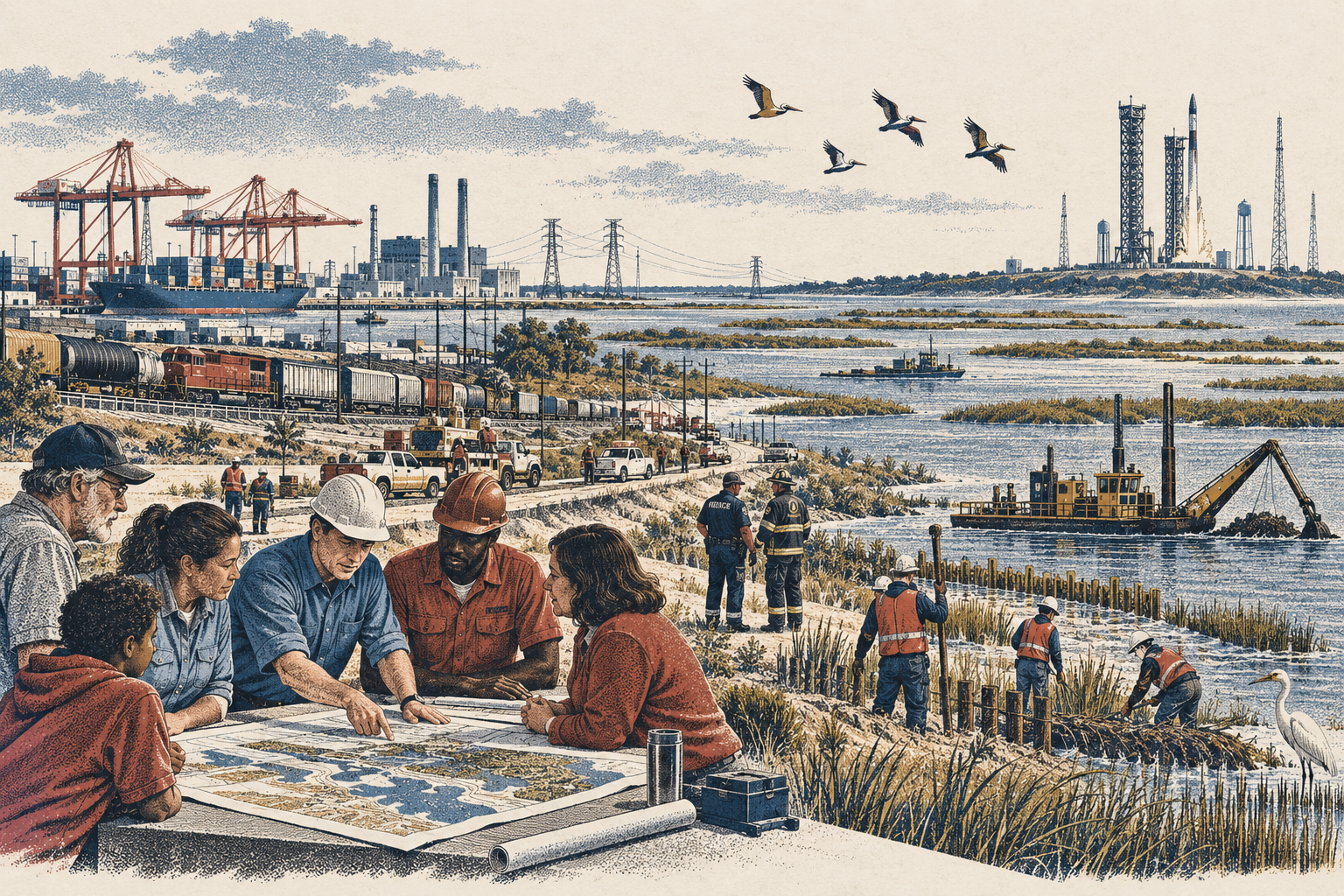
Build the public ledger before the launch tower.
The choice is not between a museum coast and a company coast. Louisiana can welcome an extraordinary project while insisting that the institutions around it grow just as deliberately as the launch site. A compact public implementation ledger would make the bargain visible:
- Milestones. Separate announcement, permitting, land transfer, infrastructure design, capital expenditure, hiring, construction, and operation. Tie public incentives to completed stages.
- Inputs. Publish expected ranges for water, power, road traffic, emergency demand, dredging, launch cadence, and housing, with revisions as engineering matures.
- Local capacity. Fund fire, medical, road, workforce, and permitting capacity before peak construction rather than asking small institutions to absorb a continental-scale project.
- Coastal accounting. Distinguish land-sale proceeds, mandatory mitigation, voluntary restoration, and fixed contractual contributions. Report acres restored or protected only when the work is designed, funded, and delivered.
- Shared upside. Track parish payments, local purchasing, apprenticeships, wage distribution, and infrastructure that remains useful even if the project changes.
This is not hostility to speed. It is how speed becomes legitimate. The Gulf Coast knows how to build. It also knows the price of discovering, decades later, that the bargain was never written down clearly enough.
That is longue durée for the next American century. Or, in plain English: take the long view and keep building.
Pecan Island is not really an island, which makes the name better.
Pecan Island sits about ten miles from the Gulf on a chenier, one of the old ridges of sand or shell that rises just enough above the surrounding marsh to carry hardwoods, houses, roads, and memory. The local word comes from the French for oak. Along the Texas-Louisiana coast, names such as Grand Chenier, Pecan Island, Hackberry, and Chenier au Tigre preserve a practical geography: find the trees and you have probably found high ground.
American place names are full of this useful imprecision. An “island” may be less a shape in water than a patch of ground that functions as one. A name can be technically wrong and geographically exact.
Louisiana Folklife · Keagan LeJeune on Pecan Island and the chenier plainPride in America is a wager on competent ambition.
Pride in America is not the belief that the country has never failed. It is the conviction that Americans can still repair what fails, and build what comes next. Some part of humanity’s off-world future may therefore speak with Louisiana and Texas in its voice. If Pecan Island becomes part of that story, the South will not merely host humanity’s departure. It will accompany it.
That sentence sounds extravagant. So did most infrastructure before somebody drew the plans, found the money, settled the obligations, and began.
Leave the light on. The republic will provide more noise tomorrow. We will keep looking past it for the work that lasts.