Volume 3 · Issue 003 · Wednesday, September 9, 2026
Dallas, and the Next Republican Question
The party knows who leads it. Now it has to show what its majority is for.
By Preserving America’s Purpose15-minute readCurrent through 10:00 p.m. CT, September 8
Fig. 010 :: Before the room decides what it is for
Before the speeches
Winning power is the easy part.
The Republican Party arrives in Dallas knowing exactly who commands the room. It is less clear what comes after the cheering. Donald Trump is the center of the party, but he will not be on the midterm ballot. Republicans will be asking voters to support a whole government, not simply one man.
That is why the apparently unrelated stories in this issue belong together. Who should control a city’s electric system? Where will the country get the power it needs? What should Brownsville demand in return for giving up authority over a piece of land? How should public schools teach the Bible? What happens when trouble in the Strait of Hormuz reaches an American gas pump? These are not side questions. They are what governing looks like once everyone goes home.
America does not need another list of abstractions. It needs affordable electricity, enough water, schools that can explain the civilization they inherited, room for local self-government, and enough energy security that a crisis overseas does not knock the country sideways. Dallas can provide the speeches. The rest has to happen in real places.
Politics
The Republican question
What comes after the cheering?
Dallas
The crowd is the easy part.
The Republican Party’s first midterm national convention opens September 9 at American Airlines Center and runs through the next day. It will not nominate anyone, adopt a platform, pass resolutions, or conduct other party business. In practice, Dallas will host an enormous campaign event: a celebration of Trump’s record, a showcase for Republican candidates, and an effort to get voters excited about November.
The question is whether it works. Trump will not be on the ballot, but control of Congress and several close state races will be. An August University of Texas poll placed Democrat James Talarico at 42% and Republican Ken Paxton at 39% in the Senate race, close enough to be a statistical tie. The same poll gave Republicans a 48–44 advantage on the generic congressional ballot. Texas is not suddenly turning blue, but Republicans cannot assume that Trump’s voters will automatically turn out for every Republican who needs them.
Dallas offers a useful bit of history. Ronald Reagan accepted the Republican nomination there in 1984 and asked, “Why are we here? What do we believe in?” The question has aged well. Today’s party has plenty of energy and no shortage of grievances. What it still needs is an answer that extends beyond Trump himself. A party can live on opposition for a while. A majority eventually has to tell people what it intends to do for the country.
Power and place
Electricity, water, and growth
Who pays, who decides, and will the thing actually work?
Texas utilities
Abbott has a point about city-owned power. He may not have the solution.
Governor Greg Abbott wants customers of Austin Energy and San Antonio’s CPS Energy to choose their electric retailer. He also wants to stop city-owned utilities from using electric revenue for unrelated city services. For now, this is a campaign proposal. There is no bill, no executive order, and no change in how either utility operates. Abbott says customers could save more than 10%, but his announcement does not show how he reached that number.
His complaint is easy to understand. Austin Energy transferred about $125 million to city purposes in fiscal 2025, and CPS plans a $559.7 million payment to San Antonio in fiscal 2027. Customers may reasonably ask how much of their bill keeps the power on and how much supports the rest of city government. Austin and San Antonio answer that their utilities are publicly owned, return money to the community, and currently advertise residential costs below the latest statewide average. The comparison is imperfect, but the cities are not obviously running high-cost disasters.
Here is the rub: Texas law now lets each municipal utility decide for itself whether to enter retail competition. Abbott would overrule that local choice in the name of giving customers more choice. Before the Legislature does that, it should compare real bills under the same assumptions, show residents exactly where the transfers go, and give customers outside city limits a meaningful voice. If the switch cannot be reversed, the people who will live with it ought to vote on it.
Energy abundance
America Needs More Power
On September 8, the Department of Energy closed a loan of up to $1.9 billion to help NextEra Energy restart Iowa’s 615-megawatt Duane Arnold nuclear plant. The reactor shut down in 2020. If the Nuclear Regulatory Commission approves the plan, NextEra expects to have it running again by early 2029.
$1.9Bmaximum federal loan closed
615 MWreactor capacity if restarted
2029target, pending NRC action
Demand is rising again after years of relative calm. The Energy Information Administration expects American electricity use to grow between 0.9% and 1.6% a year through 2050, with data centers doing much of the pushing. ERCOT has received requests for more than 474 gigawatts of new large-load connections, about 90% of them tied to data centers. Some of those projects will never exist, which is why Abbott ordered an audit. Even so, the direction is hard to miss: Texas and the rest of the country will need much more electricity than they recently expected.
America should stop treating energy sources like rival football teams. We need natural gas because it can supply dependable power relatively quickly. We need nuclear power because it can run day and night for decades. Wind, solar, and storage have useful roles, and all of them need transmission lines. We also need more fuel at home: American uranium supplied only 7% of what domestic nuclear operators bought in 2025. The fashionable argument asks which source wins. The useful question is how to provide enough reliable electricity at prices households and industry can afford.
Growth and public works
Brownsville took the deal. Now it has to make the deal work.
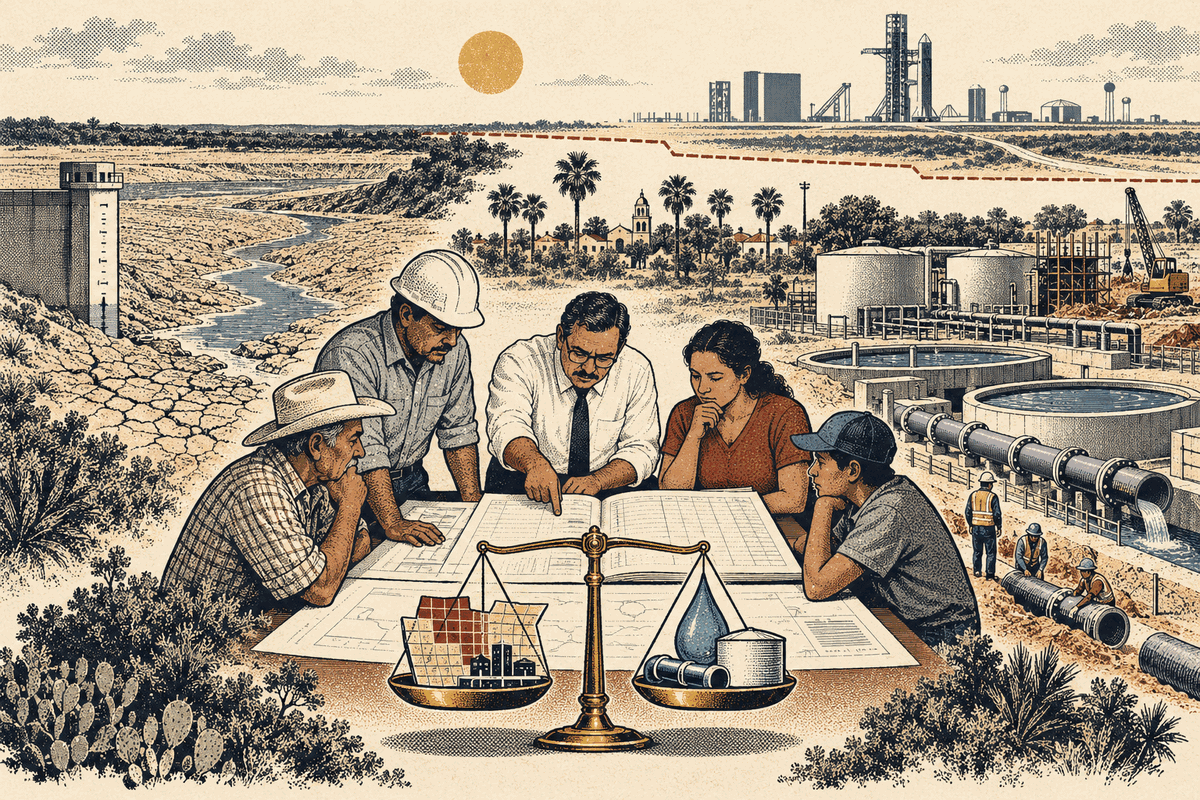
On August 29, Brownsville commissioners approved “Project Quantum.” The city gave up its jurisdiction, including zoning authority, over 444.45 privately owned acres that SpaceX has under contract. In return, SpaceX promised as much as $220 million for public water and wastewater projects. Brownsville did not sell the land. SpaceX is to put the first $40 million into escrow, then pay the remaining $180 million in installments as the city meets agreed milestones.
Brownsville said yes because it needs water. The city remains under voluntary conservation rules. The agreement could help add about 8 million gallons a day of recycled drinking water and another 10 million gallons from an expanded brackish-water plant. SpaceX does not receive ownership of that water or a reserved share of it. But the projects still need engineering and permits, and SpaceX has not said what it plans to build on the land the city can no longer zone.
This may turn out to be a very good deal. Two hundred and twenty million dollars is serious money, and Brownsville’s water problem is real. But the city gave up something real too. The public should be able to follow the agreement in plain English: Did each payment arrive? Did the permits clear? Did construction begin? Did the promised water actually reach the system? Put those answers on one public page and keep it current. A good deal will survive the sunlight.
Fig. 012 :: The bargain, before the water
History and the world
What Americans should know
Understanding the country—and the world it lives in.
Education and cultural memory
You Cannot Read America Without the Bible
On September 8, the Texas State Board of Education finished rewriting the state’s K–12 social-studies standards. In U.S. History, students will be expected to recognize the Bible as one influence on the Revolution and the new American government. The board also approved a literature list that includes biblical passages in several grades. None of this reaches a classroom before the 2030–31 school year.
The basic idea is sound. You cannot fully understand American history or literature without knowing the Bible. Lincoln’s Second Inaugural says, “Both read the same Bible,” then uses that shared scripture to deny either side an easy claim that God was entirely on its side. The language of abolition, civil rights, reform, poetry, painting, speeches, and everyday conversation is thick with biblical reference. A student who misses those references is missing part of the meaning.
The constitutional rule is not complicated. In Abington School District v. Schempp, the Supreme Court struck down school-sponsored devotional exercises while making clear that public schools may study the Bible for its history and literature. Texas should do exactly that: teach it carefully, place it beside classical thought, common law, the Enlightenment, and other religious traditions, and let students see how Americans have used the same passages to argue opposite sides. Knowing the Bible is not the same as believing it. Teaching it is not the same as preaching it.
Fig. 013 :: Reading the country’s common language
Energy security
Hormuz Is Still Everyone’s Problem
Reuters reported that only six commodity ships crossed the Strait of Hormuz on September 8, about half the recent daily average. Ship-tracking counts can miss vessels and are often revised, but the larger picture is clear. The Energy Information Administration estimates that oil moving through the strait fell from 21.6 million barrels a day in late 2025 to 4.9 million in the second quarter of 2026. Liquefied natural gas fell even more sharply.
21.6 → 4.9million barrels/day of oil, Q4 2025 to Q2 2026
10.5 → 0.8billion cubic feet/day of LNG, same period
~2.6million barrels/day of estimated available bypass capacity, June 2025
That is why backup plans matter. Saudi Arabia and the United Arab Emirates have pipelines that bypass Hormuz, but before the war EIA estimated that their available spare capacity was only about 2.6 million barrels a day. Normal traffic through the strait was close to 20 million. Storage helps. Buying from more countries helps. Domestic production helps. In March, the United States authorized the release of 172 million barrels from the Strategic Petroleum Reserve. All of those measures soften the blow. None of them makes the strait irrelevant.
Americans often hear “energy independence” and imagine that events overseas can no longer touch us. That is not how oil works. The United States imported relatively little petroleum directly through Hormuz before the war, but oil and gasoline are sold in global markets. When a major route is disrupted, American prices can still rise. The sensible goal is not to seal the country off from the world. It is to have enough domestic supply, reserves, alternate routes, and flexible refineries that a crisis abroad remains a hardship instead of becoming a catastrophe.
A
American Aside
An Ordinary Tuesday in Ruston
Most civic life is too ordinary to make the news. It looks more like the public calendar for Tuesday, September 8, in Ruston, Louisiana. The day was supposed to begin at 6:30 with breakfast at VFW Post 3615. At eight, the Chamber of Commerce had Coffee & Commerce at the Old Fire Station. The library listed storytime, crafts, and exercise. Louisiana Tech was in Welcome Week, and the volleyball team had a match.
At 5:30, the Lincoln Parish Finance Committee was due to meet. At six, the twelve-member Police Jury had an agenda that included property assessments, library-renovation bids, a transportation grant, and an appointment to a local water board. Half an hour later, live music was scheduled downtown.
No one Tuesday cures loneliness or makes local government perfect. But it shows what community looks like before somebody turns it into a theory. Someone makes the coffee, reserves the room, prints the agenda, coaches the team, tunes the guitar, and opens the door. Then people decide whether to walk in.
A majority is remembered by how ordinary life felt under it.
Did the electric bill make sense? Did the lights stay on? Did the water arrive? Did schools teach children enough history to understand their own country? Did the government handle trouble overseas without panic? Did people still have places to gather where national politics was not the only thing anyone could talk about?
Conventions matter. Elections matter more. But after the speeches and the voting, people eventually ask whether anything worked better. That is the next Republican question—and not only a Republican one.
End of Issue 003
Enough for one night. The country will still be here in the morning, complicated as ever and worth another look.
We’ll be here too, trying to make sense of it without losing sight of what is good.
Same country :: Worth another look
Fig. 014 :: Lights on. Papers stacked. See you again.
Legacy terminal :: Modern uplink active :: Still hopeful